
Our Location
304 North Cardinal St.
Dorchester Center, MA 02124


Rubies, a symbol of power, wealth and love since ancient times, are mesmerizing in their deep red color. However, the rarity of natural rubies has led to high prices and limited resources. With advances in technology, mankind has begun to explore the possibility of synthesizing rubies with the aim of recreating the beauty and brilliance of this gemstone in a controlled manner, while meeting market demand and reducing the impact on the environment.
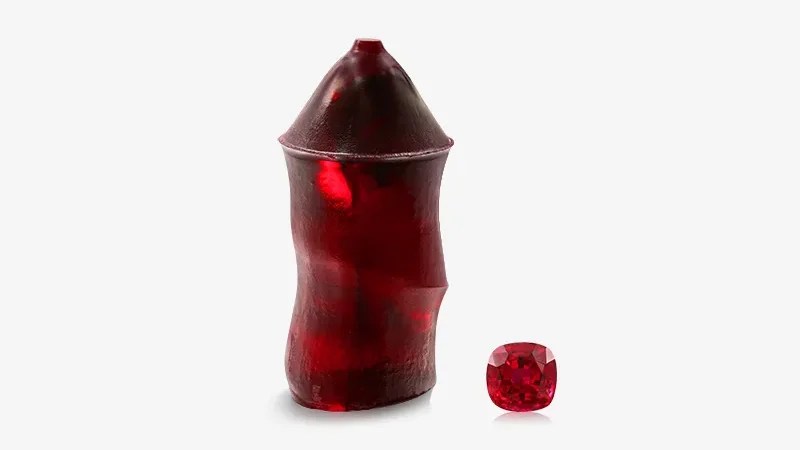
The history of synthetic ruby can be traced back to the end of the 19th century, when the French chemist Louis Werner invented the flame fusion method (also known as Werner’s method), in which ruby crystals were formed by melting aluminum oxide at high temperatures and cooling it slowly. This breakthrough not only pioneered the synthesis of gemstones, but also laid the foundation for later technological applications. Over time, scientists developed more efficient techniques, such as the hydrothermal growth method and the Czochralski method, which led to significant improvements in the quality and yield of synthetic rubies.
Flame Fusion: In this process, aluminum oxide powder is heated to its melting point and then cooled at a very slow rate through a thin tube, allowing the crystals to grow gradually. This method produces large ruby crystals, but usually contains more bubbles and impurities.
Hydrothermal Method: Crystal growth is induced by placing aluminum oxide in an autoclave at high temperatures and pressures to simulate natural conditions deep in the earth’s crust. This method produces ruby crystals of higher purity and more uniform color.
Czochralski method: In an inert gas atmosphere, a small ruby seed crystal is immersed in molten alumina and then slowly lifted and the crystal grows on the seed crystal. This method is particularly suitable for the production of high-purity single-crystal rubies and is widely used in scientific research and industry.
Composition: Synthetic rubies are chemically identical to natural rubies in terms of their aluminum trioxide (Al₂O₃). The main difference between them is the environment in which they were formed and their internal structure. Synthetic rubies can be grown under controlled conditions to achieve a very high degree of purity, with virtually no inclusions or defects, which makes them even superior to natural rubies in some respects. In addition, the color of synthetic rubies can be precisely modulated by the addition of trace elements, such as chromium, to achieve the desired color.
In terms of the original crystal shape, synthetic rubies have a pear-shaped original crystal shape, whereas natural rubies are geometrically polyhedral.
In terms of inclusions, synthetic rubies can be seen as bubbles or unfused powder, most of which are small and rounded or tadpole-like, occurring individually or in clusters.
From the color band, synthetic rubies show a typical arc-shaped growth pattern, and natural rubies with angular or hexagonal color band is very different.
Fine Jewelry Design: With its predictable quality and cost advantages, synthetic ruby is an ideal choice for jewelry designers, especially competitive in mass production.
Technological Applications: Due to its excellent optical properties and hardness, synthetic ruby is widely used in lasers, fiber optic communications, precision instruments and high-end watch mirrors.
Art & Decoration: In art creations and interior decoration, synthetic ruby’s vibrant color and unique luster make it an eye-catching element.

Although synthetic rubies and natural rubies are similar in physical properties, there is a significant difference in their value in the marketplace. Natural rubies are prized for their rarity and unique geological history, and tend to command much higher prices than synthetic rubies. However, synthetic rubies, with their consistent quality, customizable colors, and relatively low cost, appeal to a wide range of consumers, especially in industries that require large quantities of rubies. From an investment point of view, the synthetic ruby market is growing steadily, but its collectability is not comparable to that of natural rubies.
The production process of synthetic rubies has a lower environmental impact, avoiding the ecological damage and labor issues that can be associated with natural gemstone mining. In addition, the transparent supply chain and controlled production conditions ensure higher ethical standards, allowing consumers to buy with confidence and without worrying about the conflict or exploitation that may be involved with gemstones of unknown origin.

In summary, I personally believe that the emergence of synthetic rubies not only satisfies the pursuit of gemstone beauty, but also promotes technological progress and industrial innovation. Its wide application in the fields of jewelry, technology and art proves its unique value. With the continuous progress of synthetic technology, the future synthetic ruby will be closer to or even surpass the charm of natural ruby, and continue to shine on the stage of human civilization.
